
How Gir Cows Are Raised: From Grazing to Milking
“Farm fresh” gets printed on a lot of milk cartons that have never actually shown anyone a farm. What’s behind that phrase for a Gir cow herd is a fairly specific, unglamorous routine, grazing, feeding, calving cycles and twice-daily milking, none of which fits neatly into a marketing photo.
Gir cows are raised primarily through open or semi-open grazing supplemented with fodder, milked on a fixed twice-daily schedule, and managed around a notably long lactation cycle that can run close to eleven months per calving. The actual work is routine and repetitive, which is exactly what makes it hard to fake.
Grazing and Feeding
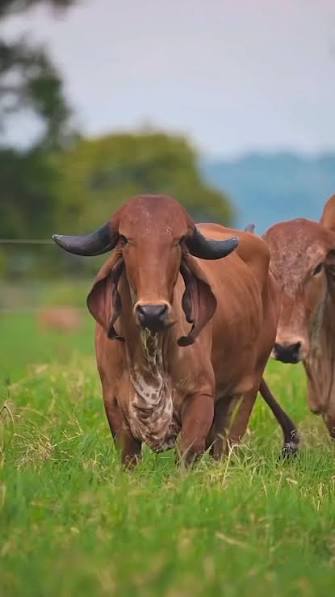
Gir cattle are built for foraging. The breed’s deep abdomen, well-sprung ribs and strong legs are physical traits suited to walking long distances while grazing, a legacy of the breed’s origin in the semi-arid Kathiawar region of Gujarat. Organized dairy herds typically combine open grazing with supplemental fodder, dry feed and mineral supplementation, since grazing alone rarely covers the nutritional demands of a lactating dairy cow producing milk for most of the year. Feed quality and consistency directly affect milk fat and yield, which is part of why milk composition varies noticeably by season even within the same herd.
The Calving and Lactation Cycle
A Gir cow’s productive life centres on a repeating cycle: calving, followed by a lactation period that can run 300 to 325 days, among the longest of any Indian indigenous breed, followed by a dry period before the next calving. That long lactation window is one of the practical reasons Gir is a preferred dairy breed, it means fewer gaps in milk supply across the year compared to shorter-lactation breeds. Calves stay close to their mothers, and Gir cattle are known for notably close maternal bonding, often described as forming a tight circle at night with calves sleeping near them.
Milking: Routine, Not a One-Time Event
Milking a dairy herd isn’t a single daily task, it’s typically done on a fixed twice-daily schedule, morning and evening, timed around the cow’s own natural rhythm rather than a delivery deadline. Consistency here matters as much as the milking itself: cows milked on an irregular schedule under stress can show measurable drops in yield and fat content. This is also the point in the process where hygiene standards either hold or don’t, milking equipment, storage temperature and the time between milking and chilling all affect whether the milk that reaches testing is actually representative of a healthy, well-managed herd.
Health and Disease Management
Part of why Gir cattle are widely used in Indian dairy farming is their natural resistance to common tropical diseases and their tolerance for heat and humidity that would stress many crossbred or European breeds. That said, “hardy breed” isn’t a substitute for actual health management, routine veterinary checks, vaccination schedules and prompt treatment of any illness remain part of running a responsible herd, regardless of how naturally resilient the breed is.
Why This Process Matters More Than the Word "Farm Fresh"
None of this is difficult to say. It’s harder to actually do consistently, every day, across an entire herd, which is exactly why the process is worth asking about rather than assuming from a label. A seller who can describe their grazing setup, feeding routine and milking schedule specifically is telling you something different from one who just repeats “farm fresh” without detail.
Where Grace of Cows Fits
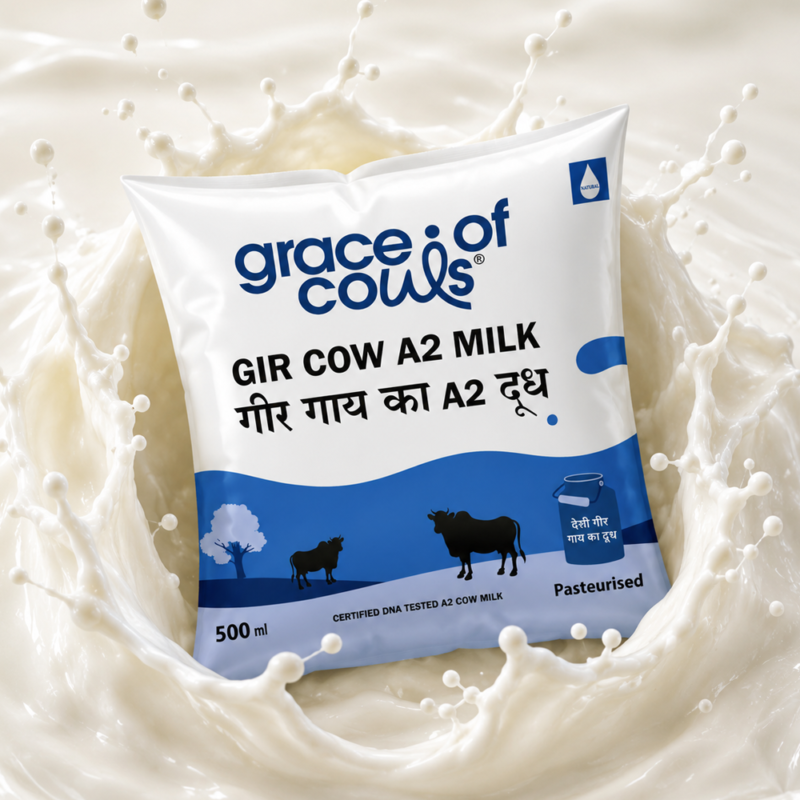
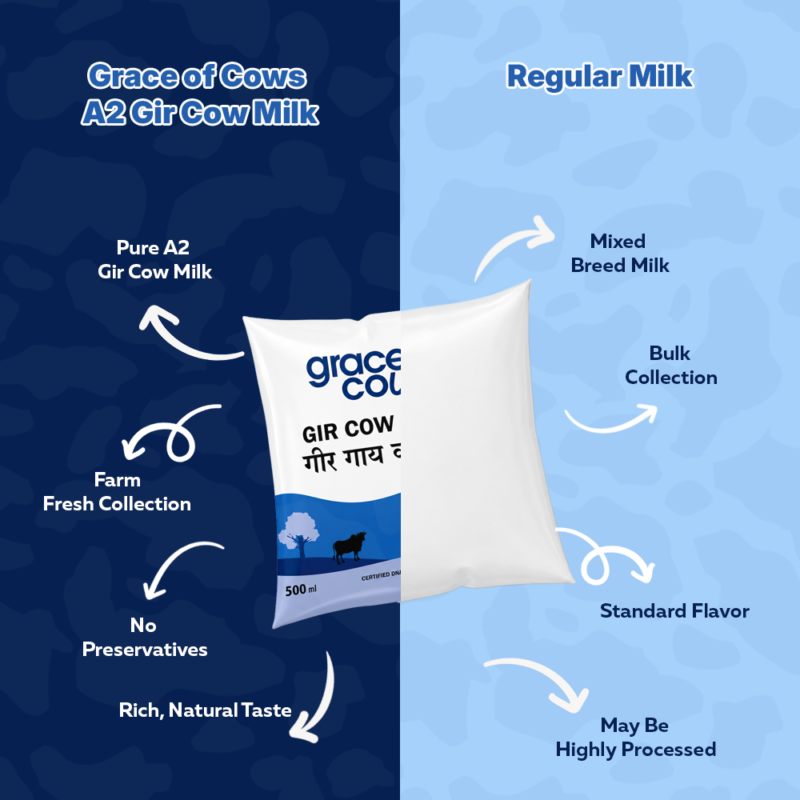
Grace of Cows raises a herd of 300+ Gir cows in Maharashtra, milk tested every day in our own dairy lab and lab tested regularly for the A2A2 gene. The same herd’s milk is also used to produce traditional Bilona ghee and fresh paneer, with delivery across Pune since 2015.
Raising Gir cows well isn’t a secret process, it’s a consistent one. The difference between a careful herd and a rushed one usually isn’t visible in a single photo, it shows up in whether the milk actually tests the same way, batch after batch.
Read the Gir cow breed guide for what defines the breed itself, how Bilona ghee is made for what happens after milking, or the Gir cow milk nutrition facts for what’s actually in the milk. Ready to try it? Order Gir cow A2 milk from Grace of Cows.
Gir cows graze where possible, since the breed is physically built for foraging, and this is usually supplemented with dry fodder and mineral supplementation on organized dairy farms, since grazing alone rarely covers the full nutritional needs of a lactating dairy cow.
Dairy herds typically milk on a fixed twice-daily schedule, morning and evening. Consistency in timing matters, since cows milked on an irregular schedule or under stress can show measurable drops in both yield and fat content.
Gir cows are known for an unusually long lactation period, often 300 to 325 days, among the longest of any Indian indigenous breed, meaning they produce milk for close to eleven months before the next dry period and calving cycle.
Gir cattle show strong natural resistance to common tropical diseases and tolerate heat well compared to many other breeds, but this doesn’t replace active health management, routine veterinary care and vaccination remain part of responsibly running any herd.
Grace of Cows raises a herd of 300+ Gir cows in Maharashtra, with milk tested every day in-house and lab tested regularly for the A2A2 gene before it’s delivered fresh across Pune or used to make traditional Bilona ghee and paneer.

