Enjoy FLAT 5% OFF on First Order | Use : WELCOME5 Enjoy FREE SHIPPING on orders above ₹799 Enjoy FLAT 5% OFF on First Order | Use : WELCOME5 Enjoy FREE SHIPPING on orders above ₹799 Enjoy FLAT 5% OFF on First Order | Use : WELCOME5 Enjoy FREE SHIPPING on orders above ₹799

How Bilona Ghee Is Made from Gir Cow Milk
“Bilona” gets printed on a lot of ghee jars that skipped most of what the word actually means. Bilona isn’t a flavour or a brand style, it’s a specific wooden churner, and the process named after it starts from curd, not cream, which is where most shortcut versions quietly diverge.

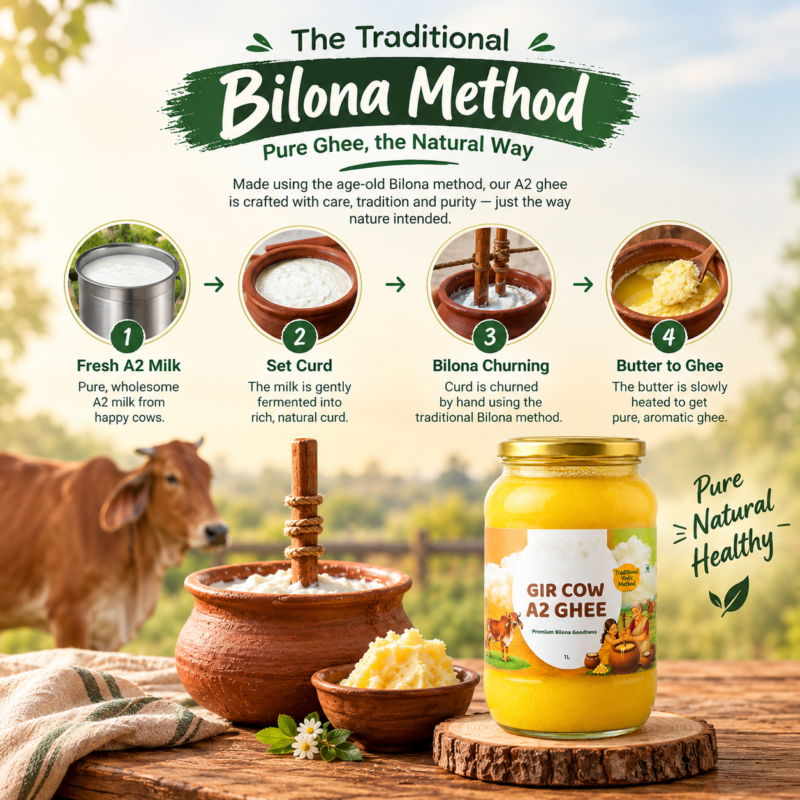
Bilona ghee is made by boiling fresh milk, cooling and culturing it into curd overnight, hand-churning that curd with a wooden bilona to separate butter from buttermilk, then slow-cooking the butter on low heat until it becomes golden, aromatic ghee. Every step in that sequence matters, and skipping the curd stage in favour of separated cream is a different, faster process that doesn’t earn the same name.

Boiling the milk

Fresh Gir cow milk is boiled and then allowed to cool to a lukewarm temperature, not hot, not cold. This step is standard across nearly every traditional account of the process and sets up the milk for culturing.

Culturing into curd

A small amount of starter curd, sometimes called jamavan, is mixed into the cooled milk. The mixture is left undisturbed in a warm place for roughly 8 to 12 hours, until it sets into a thick, well-formed curd. This fermentation step is what separates Bilona ghee from cream-based ghee entirely, there's no equivalent stage in the faster method.

Churning with the wooden bilona.

The set curd is churned using a wooden churner, the bilona itself, moved in a rhythmic clockwise and anticlockwise motion, sometimes with a little water added to help the separation. This typically takes 30 to 60 minutes of active churning. Traditional accounts consistently avoid high-speed electric churners here, since the friction and heat they generate can affect the texture of the butter.

Separating the butter

As churning continues, white butter, makkhan, collects on the surface and around the churner while a thin, pale liquid, the buttermilk (chaas), separates below. The butter is collected and typically rinsed before the next stage.

Slow-cooking into ghee

The collected butter is cooked on a low flame for roughly 1 to 2 hours. Water evaporates first, and the milk solids left behind lightly brown, which is what gives Bilona ghee its characteristic nutty aroma and golden colour. Once the liquid runs clear and bubbles settle, the ghee is strained through muslin cloth into storage jars.
Bilona vs Cream-Separator Ghee

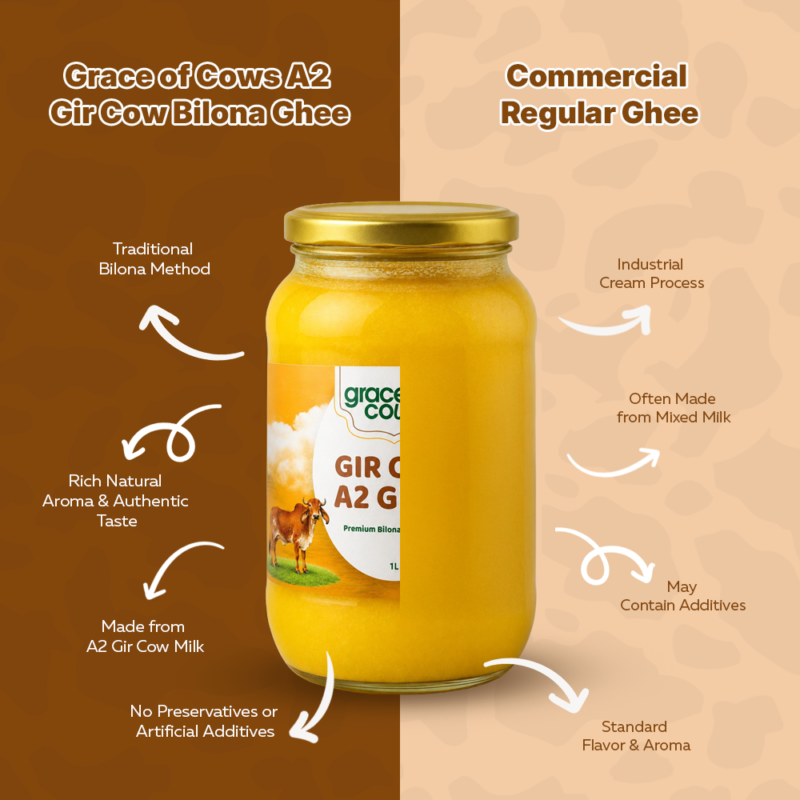
Bilona method | Cream-separator method

  • Starting point : Whole milk, fermented into curd – Cream, mechanically separated from milk
  • Fermentation stage : Yes, 8–12 hours – No
  • Churning : Hand-churned with a wooden bilona – Often machine-separated, no true churning stage
  • Time required : Several hours across multiple stages – Significantly faster
  • Byproduct : Probiotic-rich buttermilk (chaas) – Skimmed milk, not fermented buttermilk
  • Typical result : Denser, more granular texture, pronounced nutty aroma – Smoother, milder ghee

Why the Curd Stage Isn't Optional

A lot of ghee sold as “traditional” or “Bilona-style” actually starts from cream separated directly out of milk, skipping fermentation entirely and using a wooden tool only for show. That version is faster to produce and cheaper to scale, but it isn’t the same process, and it doesn’t go through the fermentation step that traditional accounts of the Bilona method treat as central, not optional. If a seller can’t describe an actual curd-setting stage before churning, what they’re selling is closer to conventional cream-based ghee with a traditional name borrowed for marketing.

Where Grace of Cows Fits

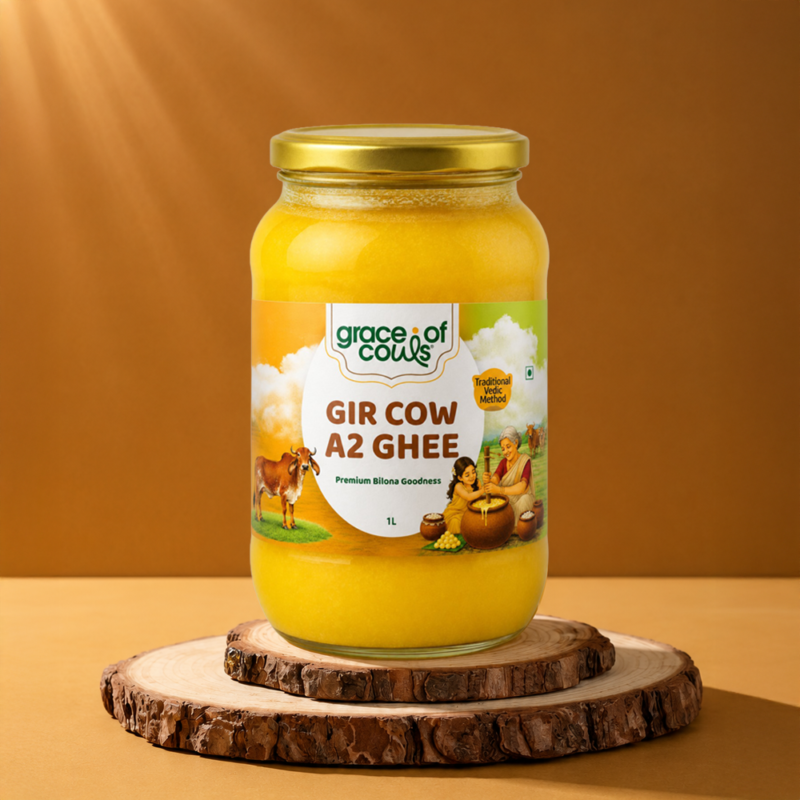
Grace of Cows makes traditional Bilona ghee from the same 300+ Gir cow herd behind our A2 milk, raised in Maharashtra and tested every day in our own dairy lab. The ghee follows the full curd-to-churn-to-ghee process rather than a cream shortcut, available alongside milk and paneer with delivery across Pune since 2015.
 
Bilona is a process, not a marketing word. The version that skips fermentation and goes straight from cream to ghee might still be good ghee, but it isn’t the traditional method the name is borrowed from, and the difference is worth asking about before paying a premium for it.

Read the Gir cow milk nutrition facts for how fat content translates into ghee yield, the Gir cow breed guide for the herd behind it, or the best A2 milk in Pune guide for how to verify any seller’s claim. Ready to try it? Order traditional Bilona ghee from Grace of Cows.

A2 Gir Cow Ghee – 1 Litre

Original price was: ₹2,800.00.Current price is: ₹1,999.00.
  • Made from the milk of Gir cows
  • Crafted using the traditional Bilona process
  • A2 ghee, known for its superior quality and health benefits
  • Rich in essential vitamins, minerals, and antioxidants
  • Smooth and creamy texture, perfect for cooking and baking
Bilona refers to the traditional wooden churner used to separate butter from curd, not a flavour, brand, or general term for “traditional.” The ghee-making method takes its name from this specific tool and the curd-churning process it’s used for.
Genuine Bilona ghee starts from curd, not cream. Milk is boiled, cooled, cultured into curd over several hours, and then churned. Ghee made by separating cream directly from milk and skipping fermentation is a different, faster process, even if marketed using the word “Bilona.”
The full process typically spans over a day: culturing milk into curd takes 8 to 12 hours, churning the curd takes 30 to 60 minutes, and slow-cooking the resulting butter into ghee takes another 1 to 2 hours on low heat.
The process involves multiple time-intensive stages, fermentation, hand-churning and slow cooking, that a faster cream-separator method skips entirely. That additional time and labour is generally reflected in the price.
Yes, Grace of Cows produces traditional Bilona ghee from the same 300+ Gir cow herd behind our A2 milk, following the full curd-to-churn-to-ghee process, with delivery across Pune since 2015.
Shopping cart
Sign in

No account yet?

Start typing to see products you are looking for.
Need Help?
Shop
0 items Cart
My account